Cica: Korea's Register Lists Centella as Four Separate Ingredients
Centella asiatica extract, madecassoside, asiaticoside, asiatic acid. Korea's MFDS register defines each separately, and only one is a plant extract. Official text.
"Cica" is a marketing shorthand, not a regulated ingredient name. On a Korean label the underlying materials appear as separate entries, and Korea's official register treats them as genuinely different things — one is a plant extract, three are isolated compounds.
That distinction is easy to lose when a product simply says "cica."
The entries, quoted
From the cosmetic raw ingredient database maintained by Korea's Ministry of Food and Drug Safety (MFDS), via the Public Data Portal at data.go.kr.
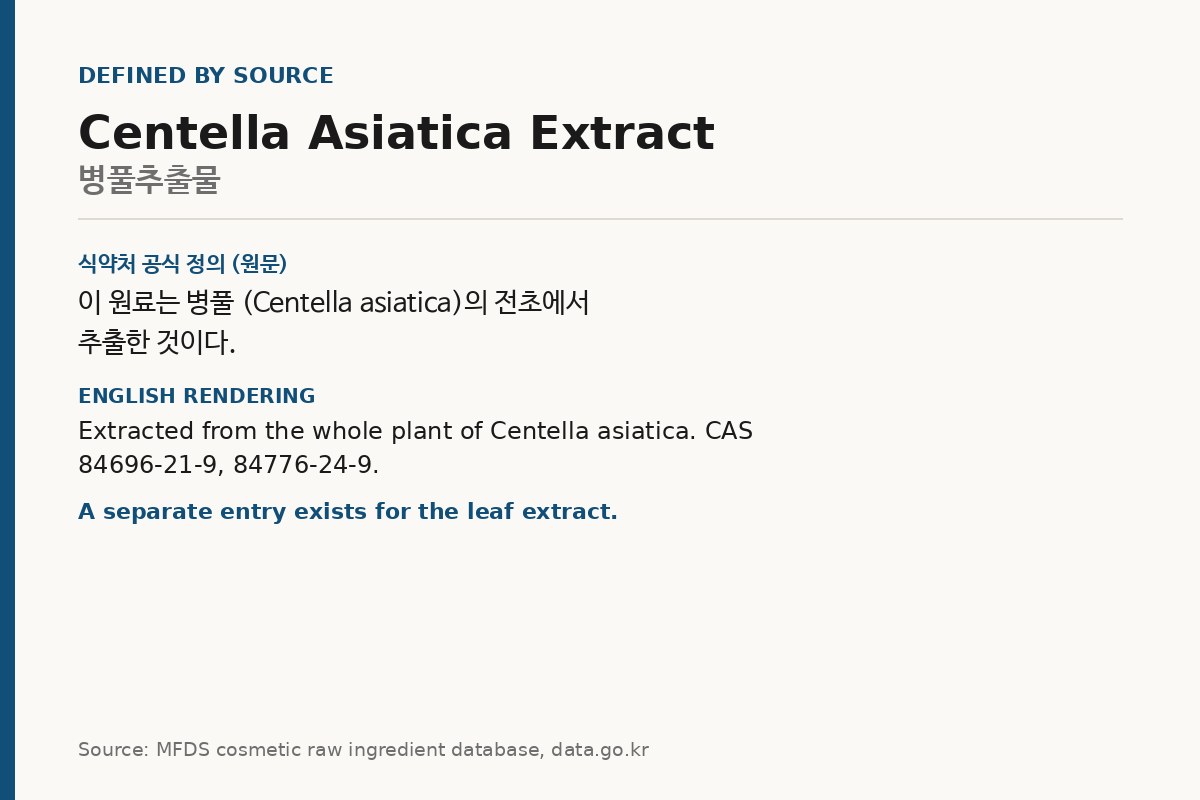
Centella Asiatica Extract (병풀추출물)
이 원료는 병풀 (Centella asiatica)의 전초에서 추출한 것이다.
Extracted from the whole plant (전초) of Centella asiatica. CAS 84696-21-9, 84776-24-9.
Centella Asiatica Leaf Extract (병풀잎추출물)
이 원료는 병풀 Centella asiatica의 잎에서 추출한 것이다.
Extracted from the leaf of Centella asiatica. A separate entry from the whole-plant extract above.
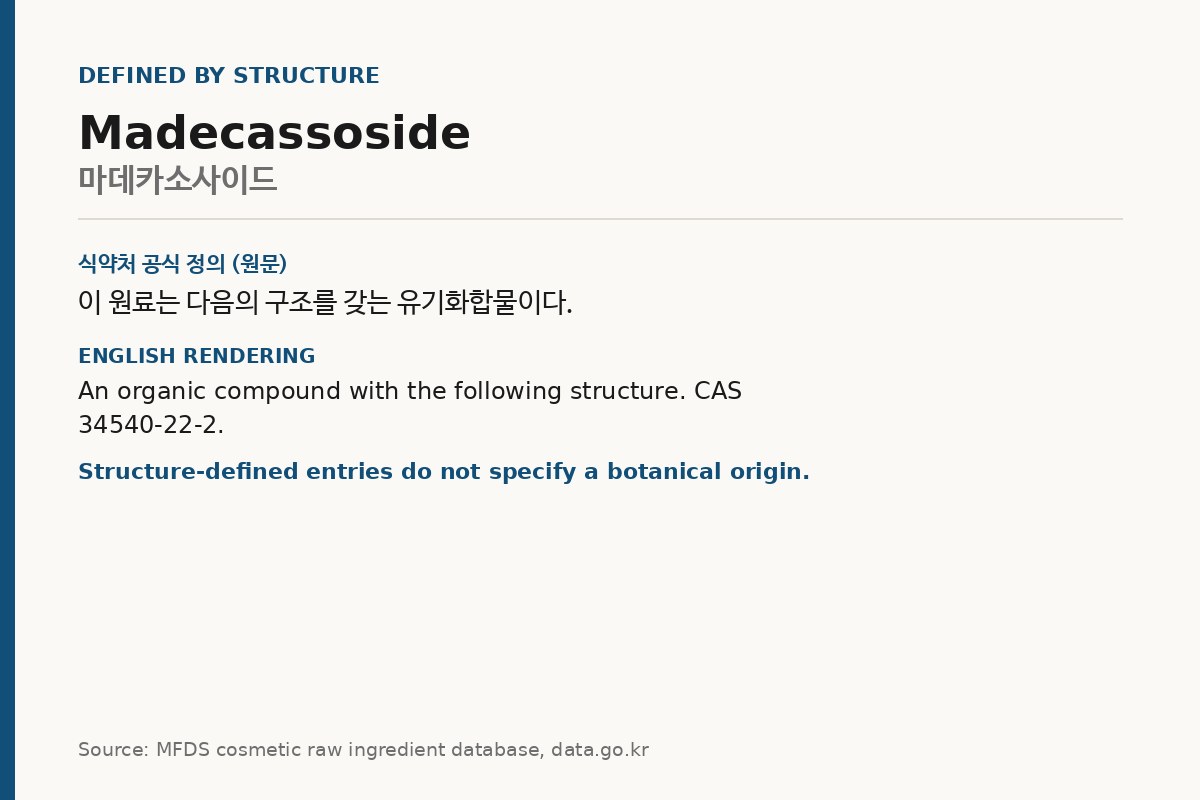
Madecassoside (마데카소사이드)
이 원료는 다음의 구조를 갖는 유기화합물이다.
An organic compound with the following structure. CAS 34540-22-2.
Asiaticoside (아시아티코사이드) and Asiatic Acid (아시아틱애씨드)
이 원료는 다음의 구조를 갖는 유기화합물이다.
Both carry the identical definition sentence: an organic compound with the following structure.
The structural difference that matters
Read the definitions by type rather than by name and the set splits cleanly in two.
The extracts are defined by source — which plant, which plant part. An extract is a mixture; the register does not enumerate what is in it.
The isolated compounds — madecassoside, asiaticoside, asiatic acid — are defined by structure. The phrase 다음의 구조를 갖는 유기화합물 ("an organic compound having the following structure") points to a structural diagram in the source record rather than to a botanical origin.
This has a practical consequence. A product listing madecassoside is not necessarily listing a plant extract at all. The register defines that ingredient by its molecular structure, and structure-defined entries do not specify how the material was obtained — extraction from the plant and synthesis both satisfy a structural definition.
Whole plant versus leaf
The register maintains two separate extract entries, and the only difference stated between them is the plant part: 전초 (whole plant) versus 잎 (leaf). Both share the same base CAS reference.
The register does not say the two differ in composition, and it does not say they are equivalent. It records the distinction and stops there. Any claim that one is richer in a particular constituent is a claim from outside this source.
What none of the entries state
- No efficacy claim. Not soothing, not repairing, not calming. The word does not appear in any of the five definitions.
- No constituent profile for the extracts. The register does not say how much madecassoside is in Centella Asiatica Extract, or that it contains any.
- No concentration minimum for any of the five.
- No extraction solvent or method.
Reading a "cica" product label
Given the above, the useful question is not whether a product says "cica" but which registered entries appear:
- An extract entry tells you plant material was used, and which part.
- An isolated compound entry tells you a specific molecule is present, defined by structure.
- Both together tell you both were added — not that one was derived from the other.
None of the entries indicate quantity, so ordering within the ingredient list remains the only rough signal, and only where the material appears near the top.
What this article does not cover
- Clinical evidence for centella or its constituents. Outside the scope of a compositional register; no claim is made here.
- Whether extract or isolate is preferable. The register ranks nothing.
- How any specific product's madecassoside was produced. Not stated on labels and not in this record.
How to verify this
- The dataset is published by MFDS through Korea's Public Data Portal (data.go.kr) as cosmetic raw ingredient information.
- Search 병풀추출물, 병풀잎추출물, 마데카소사이드, 아시아티코사이드, 아시아틱애씨드.
- Korean text above is quoted verbatim; English renderings are this site's translation.
Source: Cosmetic raw ingredient information published by Korea's Ministry of Food and Drug Safety (MFDS) via the Public Data Portal, data.go.kr.
Photos by 604always withlove, Real Seoul Daily, Real Seoul Daily via Pexels