Ferment Filtrate: What Korea's Register Says About Galactomyces and Bifida
Galactomyces, Saccharomyces, Bifida, Lactobacillus, rice ferment. Korea's MFDS register defines each in one sentence. The official text, quoted and compared.
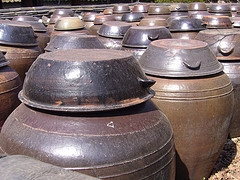
Fermentation is the story Korean skincare tells about itself more than any other. Product copy describes ferment filtrates as more bioavailable, more refined, gentler. Korea's official cosmetic ingredient register describes each of them in a single sentence about process, and nothing else.
Below are five ferment entries quoted from the register, side by side. Reading them together shows what the ingredient names do and do not distinguish.
The five entries
All text is from the cosmetic raw ingredient database maintained by Korea's Ministry of Food and Drug Safety (MFDS), published via the Public Data Portal at data.go.kr.
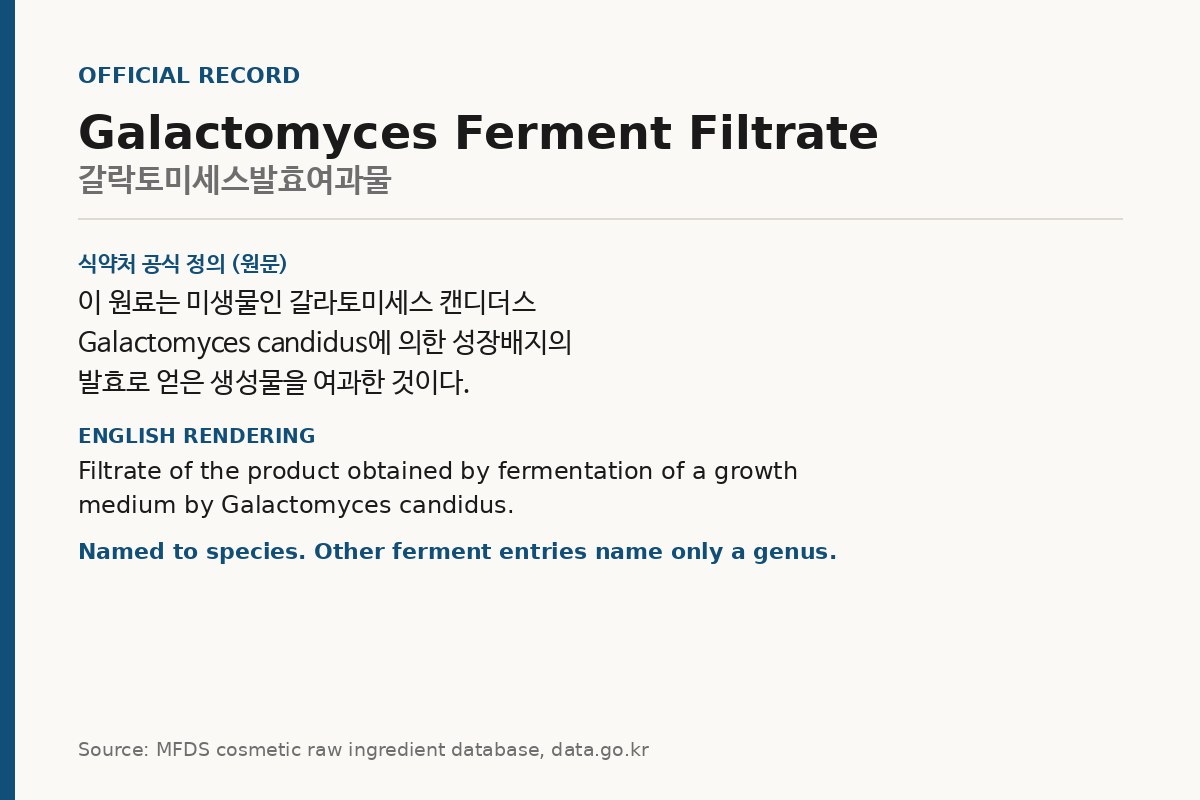
Galactomyces Ferment Filtrate (갈락토미세스발효여과물)
이 원료는 미생물인 갈라토미세스 캔디더스 Galactomyces candidus에 의한 성장배지의 발효로 얻은 생성물을 여과한 것이다.
Filtrate of the product obtained by fermentation of a growth medium by the microorganism Galactomyces candidus.
Saccharomyces Ferment Filtrate (효모발효여과물)
이 원료는 미생물 효모를 배양 발효시켜 얻은 생성물을 여과한 것이다.
Filtrate of the product obtained by culturing and fermenting yeast.
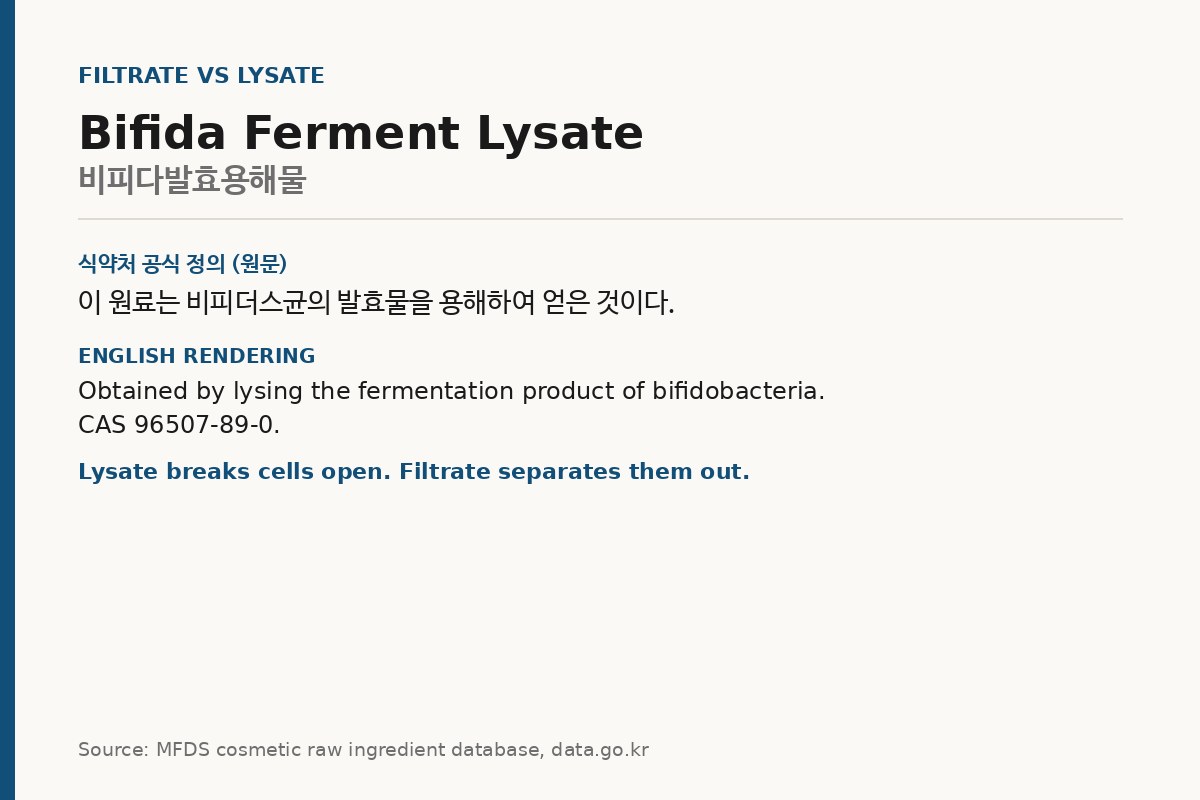
Bifida Ferment Lysate (비피다발효용해물)
이 원료는 비피더스균의 발효물을 용해하여 얻은 것이다.
Obtained by lysing the fermentation product of bifidobacteria. CAS 96507-89-0.
Lactobacillus Ferment (락토바실러스발효물)
이 원료는 미생물의 일종인 락토바실러스 Lactobacillus를 발효하여 얻은 생성물이다.
The product obtained by fermenting the microorganism Lactobacillus.
Rice Ferment Filtrate, Sake (쌀발효여과물)
이 원료는 쌀 (Oryza sativa)을 발효하고 여과하여 얻은 것이다.
Obtained by fermenting and filtering rice (Oryza sativa). The register's English name carries a parenthetical: Rice Ferment Filtrate (Sake).
Three distinctions the register does make
Filtrate versus lysate. This is a real difference in process and it is visible in the names. A filtrate (여과물) is what passes through filtration — the liquid, with cells separated out. A lysate (용해물) is produced by breaking cells open, so cellular contents are part of the material. Bifida Ferment Lysate is the lysate in this set; the others are filtrates or unqualified ferments.
Species specificity varies sharply. Galactomyces Ferment Filtrate names one organism down to species: Galactomyces candidus. Lactobacillus Ferment names only the genus. Saccharomyces Ferment Filtrate says simply "yeast" (효모). These are three different levels of precision inside the same product category.
What was fermented, sometimes. The rice entry names the substrate — rice. Galactomyces names a "growth medium" (성장배지) without specifying its composition. The others do not address substrate at all.
What none of them state
- No efficacy. Not one of the five entries claims an effect on skin. Fermentation is described as a process, not as a benefit.
- No fermentation conditions. Duration, temperature, and strain lineage are absent throughout.
- No composition of the result. A filtrate is defined by how it was separated, not by what ended up in it.
- No concentration floor. Nothing sets a minimum for any of them.
The last point deserves weight. Because the register defines these materials by process rather than by content, two filtrates produced by different manufacturers under the same ingredient name are not guaranteed to be comparable. The name certifies a method, not an outcome.
Why "fermented" is a weak comparison tool
If you are comparing two essences and both list a ferment filtrate, the ingredient names alone will not tell you which contains more, which used a better-characterised strain, or whether the fermentation was optimised for anything in particular. Those questions sit outside the register entirely.
What the names can tell you is genuinely useful, and it is narrower than most product pages suggest: which organism (sometimes to species, sometimes only to genus), and whether the material is a filtrate or a lysate.
What this article does not cover
- Whether fermented ingredients outperform non-fermented ones. That is a question for published research, not for a compositional register, and no claim is made here in either direction.
- Specific products or concentrations. Not knowable from ingredient names.
- Whether any strain is superior. The register ranks nothing.
How to verify this
- The dataset is published by MFDS through Korea's Public Data Portal (data.go.kr) as cosmetic raw ingredient information.
- Search the Korean names 갈락토미세스발효여과물, 효모발효여과물, 비피다발효용해물, 락토바실러스발효물, 쌀발효여과물.
- Korean text above is quoted verbatim; English renderings are this site's translation.
Source: Cosmetic raw ingredient information published by Korea's Ministry of Food and Drug Safety (MFDS) via the Public Data Portal, data.go.kr.
Images by Wolfetone at English Wikipedia (Public domain), Real Seoul Daily, Real Seoul Daily via Wikimedia Commons