Hyaluronic Acid vs Sodium Hyaluronate: Korea's Register Is Blunt About It
Three hyaluronic ingredients appear on Korean labels. The MFDS register defines each in one line, and the difference between them is simpler than marketing suggests.
Product pages spend a lot of words on molecular weight, penetration depth, and multi-layer hydration. Korea's official cosmetic ingredient register defines the three most common hyaluronic entries in one sentence each, and the relationships between them turn out to be simple.
The three entries
From the cosmetic raw ingredient database maintained by Korea's Ministry of Food and Drug Safety (MFDS), published via the Public Data Portal at data.go.kr.
Hyaluronic Acid (하이알루로닉애씨드)
이 원료는 N-아세틸-D-글루코사민과 글루쿠로닉애씨드의 결합으로 얻은 천연의 뮤코폴리사카라이드이다.
A natural mucopolysaccharide obtained from the combination of N-acetyl-D-glucosamine and glucuronic acid.
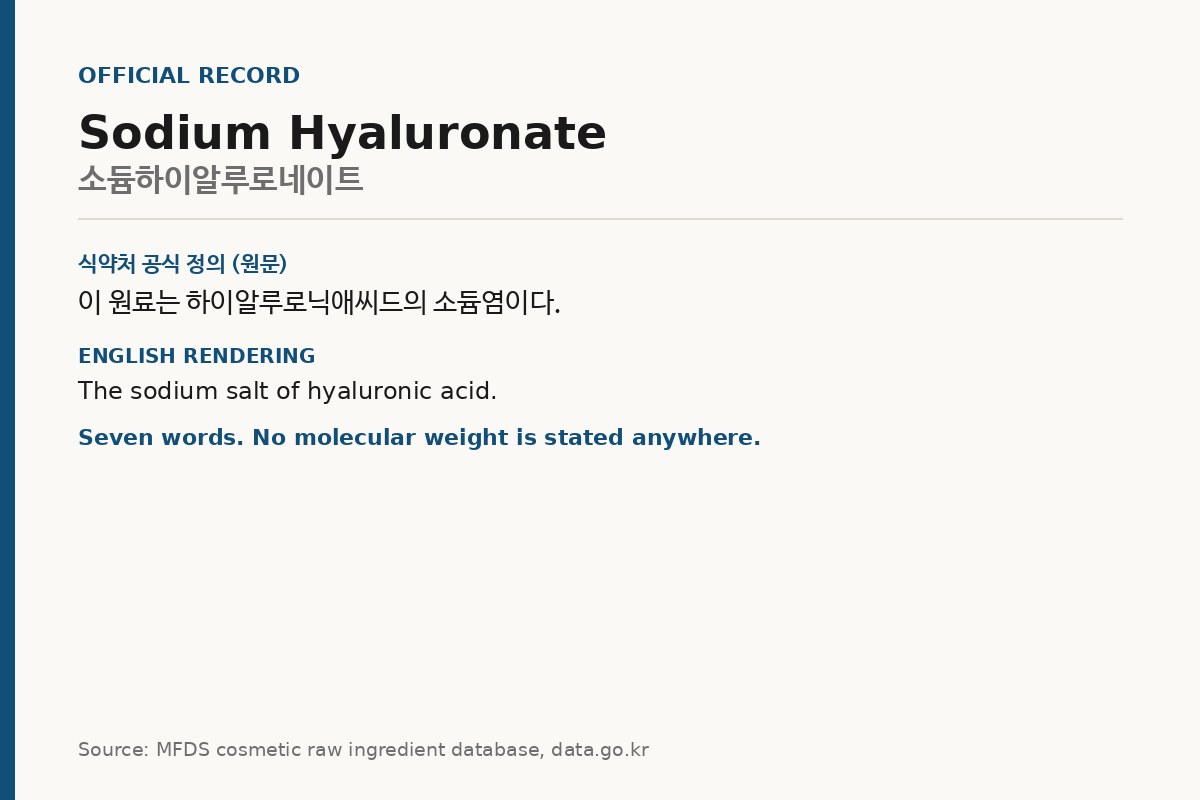
Sodium Hyaluronate (소듐하이알루로네이트)
이 원료는 하이알루로닉애씨드의 소듐염이다.
The sodium salt of hyaluronic acid.
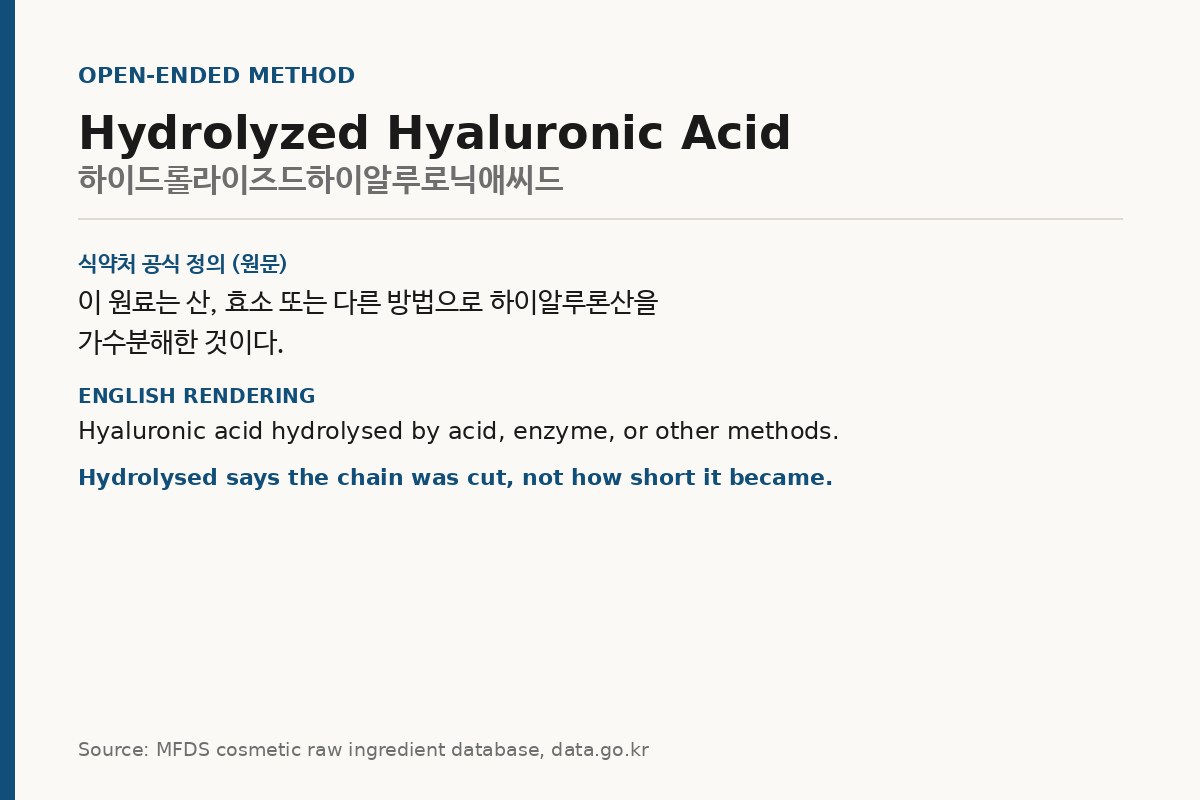
Hydrolyzed Hyaluronic Acid (하이드롤라이즈드하이알루로닉애씨드)
이 원료는 산, 효소 또는 다른 방법으로 하이알루론산을 가수분해한 것이다.
Hyaluronic acid hydrolysed by acid, enzyme, or other methods.
Reading them together
Laid out side by side, the register is describing one parent material and two derivatives.
- Hyaluronic acid is the base polysaccharide, defined by its two building blocks.
- Sodium hyaluronate is that same molecule as a sodium salt. The definition is seven words long and contains no other qualification.
- Hydrolyzed hyaluronic acid is the parent broken into smaller pieces. The definition explicitly allows several routes — acid, enzyme, or other methods.
Two observations follow directly from the text.
The register does not state molecular weight for any of them. Not for the parent, not for the salt, and — this is the notable one — not for the hydrolysed form. "Hydrolysed" establishes that the chain was cut. It does not establish how short the resulting fragments are.
The hydrolysis method is open. The phrase 또는 다른 방법으로 ("or other methods") means the ingredient name covers materials produced by processes the register does not enumerate.
What this means for label reading
Marketing frequently frames these as a hydration ladder: large molecules on the surface, small molecules deeper. Whatever the merits of that framing, the ingredient names on a Korean label do not encode it.
- Seeing "Sodium Hyaluronate" tells you the salt form was used. It tells you nothing about chain length.
- Seeing "Hydrolyzed Hyaluronic Acid" tells you the material was cut down. It does not tell you to what size.
- Listing all three tells you three registered materials are present. It does not, by itself, demonstrate a designed molecular-weight distribution.
Where a brand specifies molecular weights in daltons, that is a voluntary claim sitting outside the registered ingredient name — the same situation as source claims for squalane. The register has no field for it.
A note on the salt form
The sodium hyaluronate entry is one of the shortest in this part of the register: "the sodium salt of hyaluronic acid." It defines by reference to the parent entry and adds nothing else. Anyone expecting the register to explain why formulators favour the salt form will not find it here — that reasoning belongs to formulation science, not to a compositional record.
What this article does not cover
- Whether molecular weight changes performance. A live research question, and outside the scope of an ingredient definition.
- Concentrations in any product. Not stated by the register and not inferable from a label.
- Which form is preferable. The register ranks nothing.
How to verify this
- The dataset is published by MFDS through Korea's Public Data Portal (data.go.kr) as cosmetic raw ingredient information.
- Search 하이알루로닉애씨드, 소듐하이알루로네이트, 하이드롤라이즈드하이알루로닉애씨드.
- Korean text above is quoted verbatim; English renderings are this site's translation.
Source: Cosmetic raw ingredient information published by Korea's Ministry of Food and Drug Safety (MFDS) via the Public Data Portal, data.go.kr.
Images by Wikimedia contributor (Public domain), Real Seoul Daily, Real Seoul Daily via Wikimedia Commons