Green Tea, Ginseng, Mugwort: Korea's Register Names the Plant Part
Korean botanical extracts are defined by species and plant part, not by effect. Two mugworts are listed as separate ingredients. The official definitions, quoted.
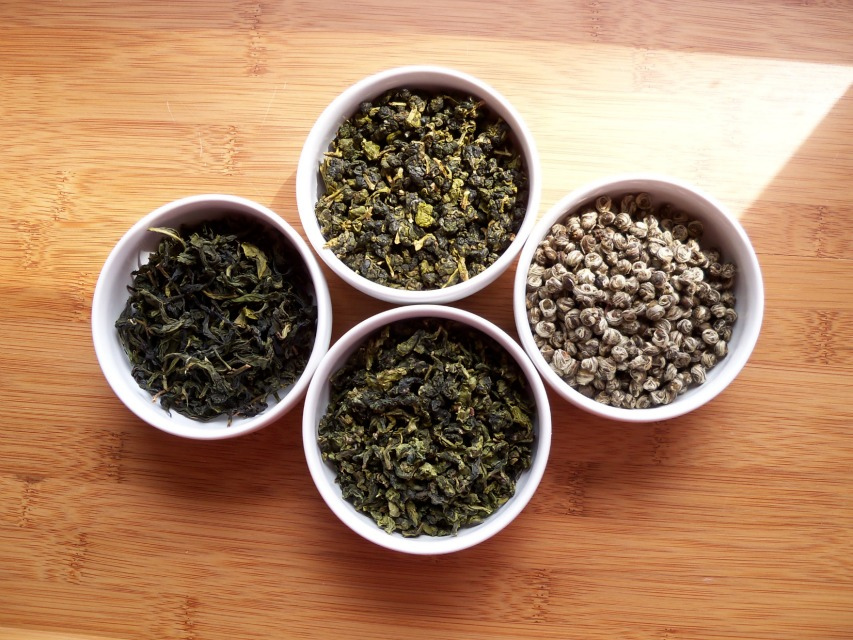
Botanical entries in Korea's cosmetic ingredient register follow a strict pattern: name the species in Latin, name the plant part, stop. No effect is described. Once you see the pattern, several things on Korean labels become easier to read — including the fact that "mugwort" is two different registered ingredients.
The entries
From the cosmetic raw ingredient database maintained by Korea's Ministry of Food and Drug Safety (MFDS), via the Public Data Portal at data.go.kr.
Camellia Sinensis Leaf Extract — green tea (녹차추출물)
이 원료는 차나무(녹차) Camellia Sinensis의 잎에서 추출한 것이다.
Extracted from the leaf of the tea plant (green tea), Camellia sinensis.
Camellia Japonica Seed Oil (동백나무씨오일)
이 원료는 동백나무 Camellia Japonica의 씨에서 얻은 고정유(불휘발성 오일)이다.
A fixed (non-volatile) oil obtained from the seed of Camellia japonica.
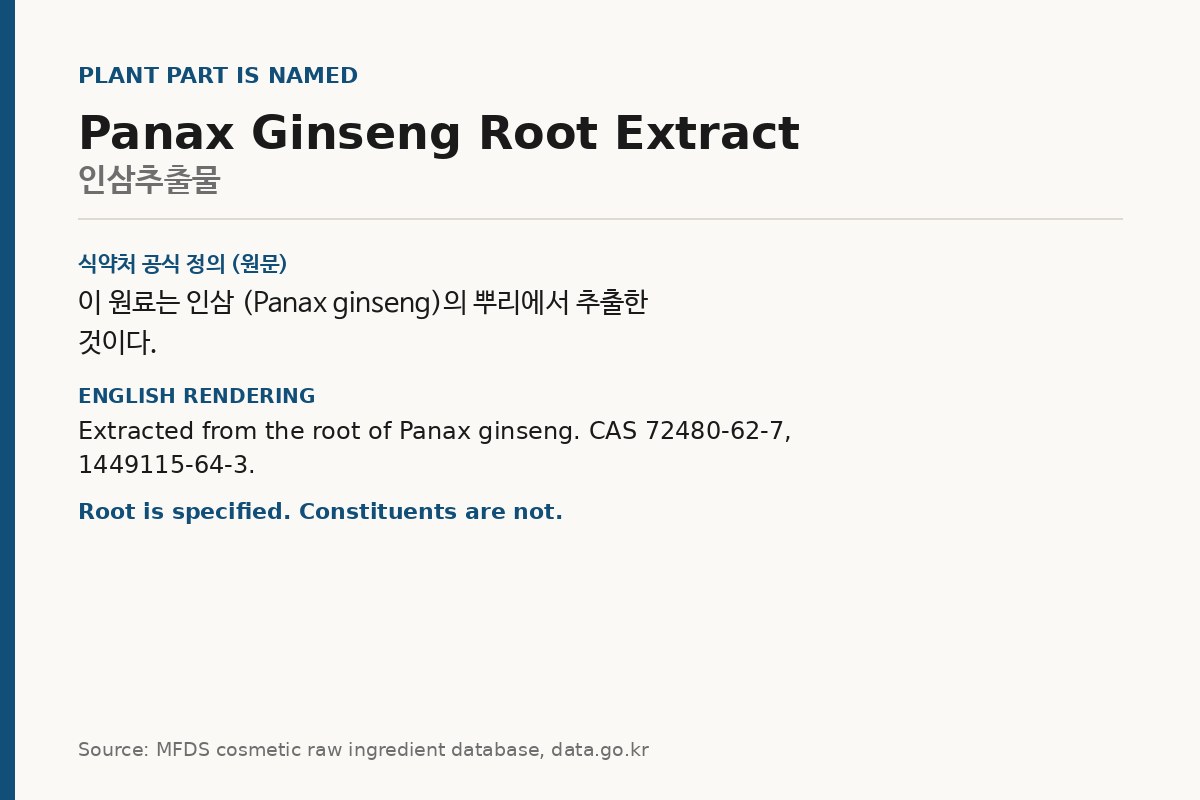
Panax Ginseng Root Extract (인삼추출물)
이 원료는 인삼 (Panax ginseng)의 뿌리에서 추출한 것이다.
Extracted from the root of Panax ginseng. CAS 72480-62-7, 1449115-64-3.
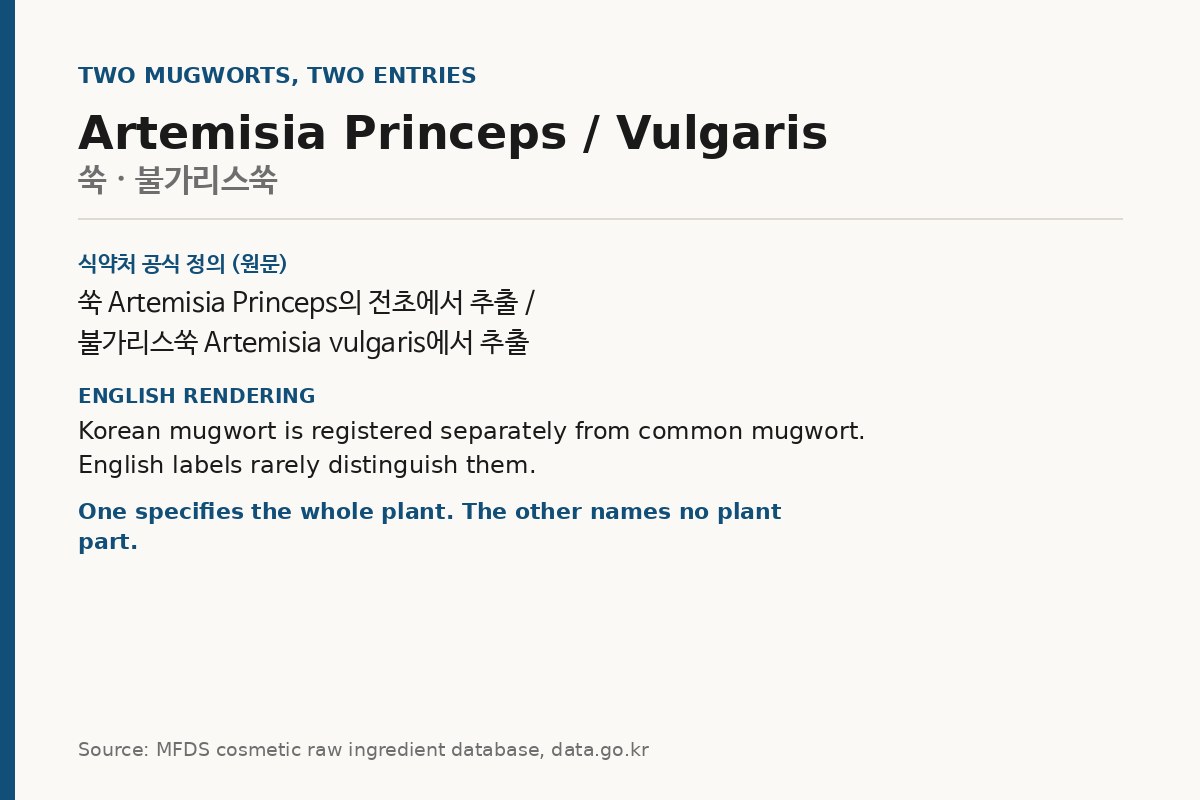
Artemisia Princeps Extract — Korean mugwort (쑥추출물)
이 원료는 쑥 Artemisia Princeps의 전초에서 추출한 것이다.
Extracted from the whole plant of Artemisia princeps.
Artemisia Vulgaris Extract — common mugwort (불가리스쑥추출물)
이 원료는 불가리스쑥 Artemisia vulgaris에서 추출한 것이다.
Extracted from Artemisia vulgaris. Note that this entry does not specify a plant part.
Houttuynia Cordata Extract (약모밀추출물)
이 원료는 약모밀 Houttuynia cordata에서 추출한 것이다.
Extracted from Houttuynia cordata. Also no plant part specified.
Two mugworts, two entries
English-language product copy generally says "mugwort." The register lists two distinct species under two distinct ingredient names, and the Korean names make the distinction visible: 쑥 for Artemisia princeps, 불가리스쑥 for Artemisia vulgaris.
The register does not state that the two are equivalent, and it does not state that they differ in composition. It simply registers them separately. A label saying "mugwort extract" in English is therefore ambiguous in a way the Korean ingredient name is not — and the standardised English names on the register (Artemisia Princeps Extract, Artemisia Vulgaris Extract) preserve the distinction if you look for them.
Plant part is specified — sometimes
The pattern is not uniform, and the inconsistency is itself informative:
- Part specified: green tea (leaf), camellia (seed), ginseng (root), Korean mugwort (whole plant).
- Part not specified: common mugwort, houttuynia.
Where the part is named, the ingredient name carries real information — ginseng root extract is not the same registered material as an extract of another part would be. Where the part is absent, the ingredient name does not narrow it down.
One more detail worth noticing: the camellia seed entry is the only one here that classifies the material type as well as the source, calling it a 고정유 — a fixed, non-volatile oil. That distinguishes it from an essential oil, and it is a distinction the register bothers to draw.
What none of these entries state
- No effect on skin. Not soothing, not antioxidant, not brightening. The definitions describe origin only.
- No constituent profile. The green tea entry does not mention catechins; the ginseng entry does not mention ginsenosides. An extract is defined by where it came from, not by what is in it.
- No extraction solvent, ratio, or concentration.
- No growing region. "Korean-grown" claims sit outside the registered name.
What this article does not cover
- Research on any of these botanicals. Outside the scope of a compositional register; no claim is made here.
- Whether one species outperforms another. The register ranks nothing.
- Traditional use. A separate subject from ingredient registration.
How to verify this
- The dataset is published by MFDS through Korea's Public Data Portal (data.go.kr) as cosmetic raw ingredient information.
- Search 녹차추출물, 동백나무씨오일, 인삼추출물, 쑥추출물, 불가리스쑥추출물, 약모밀추출물.
- Korean text above is quoted verbatim; English renderings are this site's translation.
Source: Cosmetic raw ingredient information published by Korea's Ministry of Food and Drug Safety (MFDS) via the Public Data Portal, data.go.kr.
Images by A Girl With Tea from USA (CC BY 2.0), Real Seoul Daily, Real Seoul Daily via Wikimedia Commons