Niacinamide, Adenosine, Retinol: Defined by Structure, Not by Source
Korea's MFDS register defines the common actives by molecular structure alone. One entry reveals a parent-derivative relationship most labels never explain.

Korea's cosmetic ingredient register defines botanical materials by where they came from, and it defines the common actives by what they are. Reading the two groups side by side makes a structural point that matters when you are comparing labels.
The entries
From the cosmetic raw ingredient database maintained by Korea's Ministry of Food and Drug Safety (MFDS), via the Public Data Portal at data.go.kr.
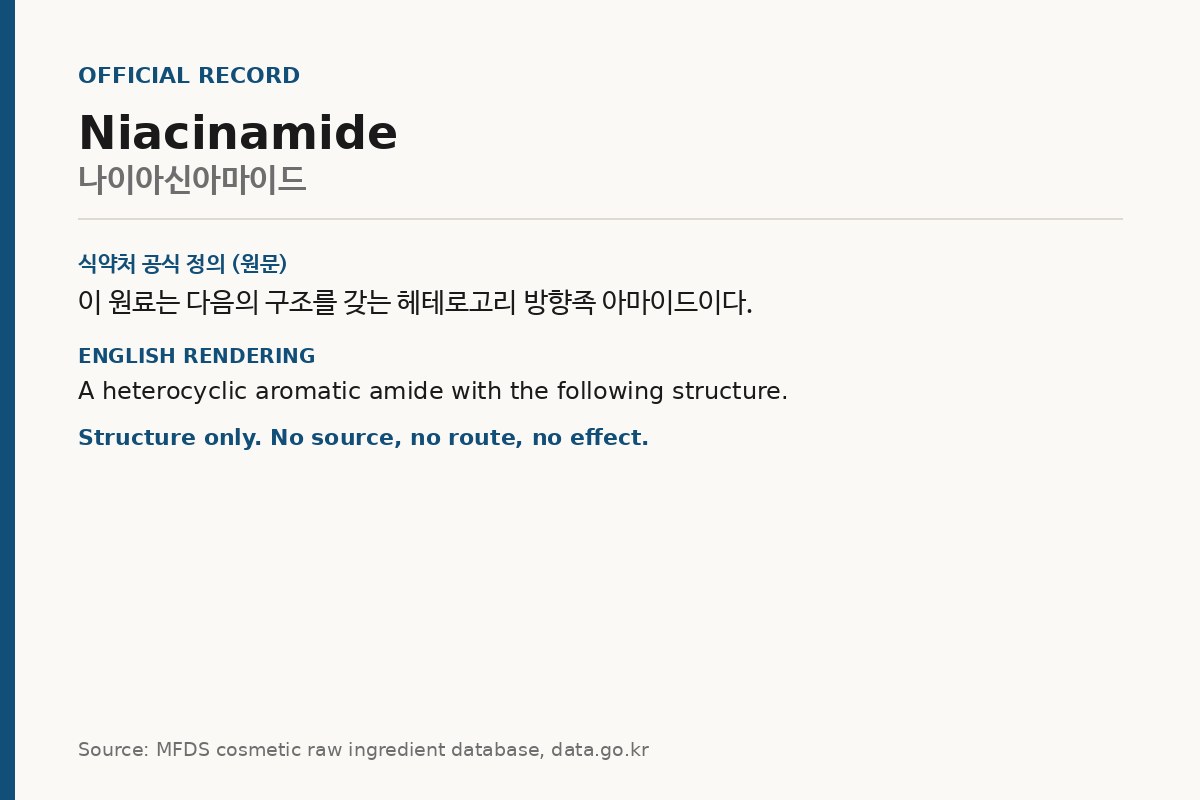
Niacinamide (나이아신아마이드)
이 원료는 다음의 구조를 갖는 헤테로고리 방향족 아마이드이다.
A heterocyclic aromatic amide with the following structure.
Adenosine (아데노신)
이 원료는 다음의 구조를 갖는 헤테로사이클릭 유기화합물이다.
A heterocyclic organic compound with the following structure.
Arbutin (알부틴), Ascorbic Acid (아스코빅애씨드), Retinol (레티놀)
이 원료는 다음의 구조를 갖는 유기화합물이다.
All three carry the identical sentence: an organic compound with the following structure.
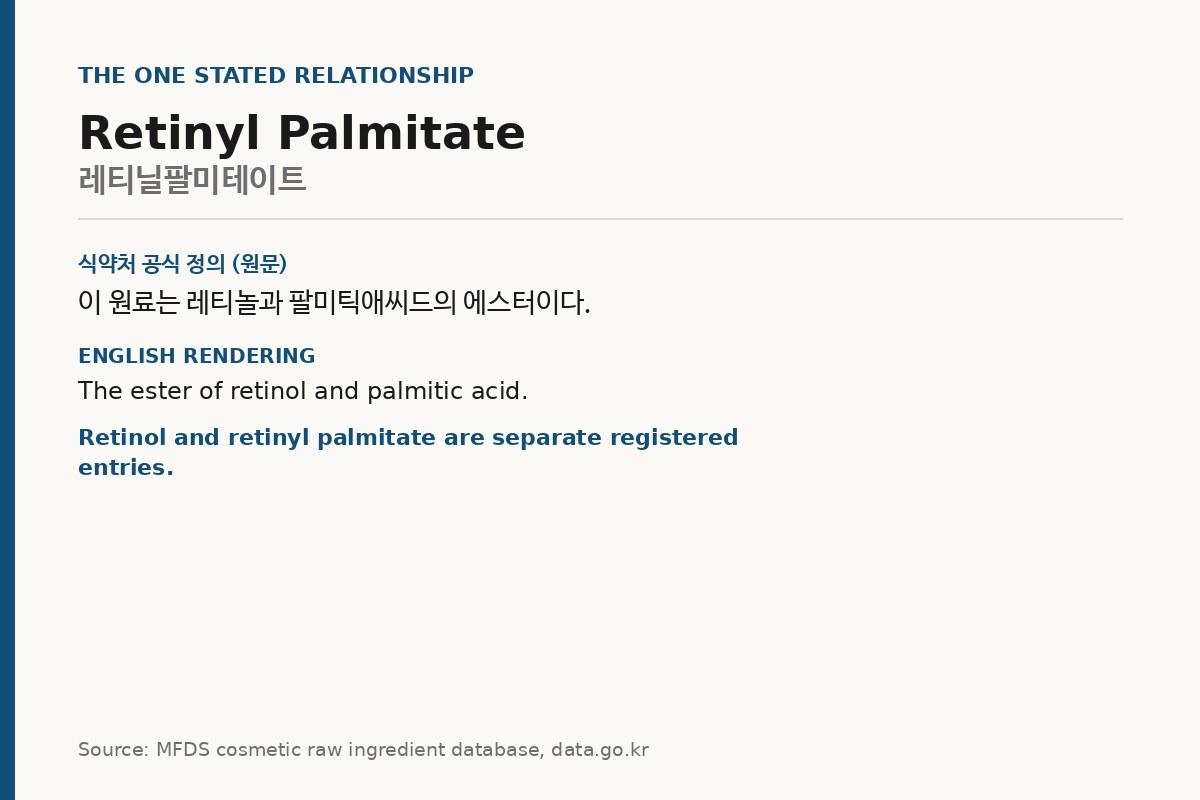
Retinyl Palmitate (레티닐팔미테이트)
이 원료는 레티놀과 팔미틱애씨드의 에스터이다.
The ester of retinol and palmitic acid.
Ethyl Ascorbyl Ether (에칠아스코빌에텔)
이 원료는 다음의 구조를 갖는 유기화합물이다.
An organic compound with the following structure.
The one entry that states a relationship
Most of these definitions point outward to a structural diagram and say nothing else. Retinyl palmitate is the exception, and it is the most informative line in the set: it defines the material by naming its two parents — retinol and palmitic acid — joined as an ester.
The register states the chemical relationship plainly. It does not state that one converts into the other on skin, or at what rate, or how the two compare in use. Those are questions the register does not address, and this article will not answer them from an ingredient definition.
What you can take from the entry is narrower and still useful: on a Korean label, retinol and retinyl palmitate are not interchangeable names for the same registered material. They are separate entries, and one is defined as a derivative of the other.
Structure-defined means source-silent
Every entry above is defined by molecular structure. None names a plant, an animal, or a manufacturing route. That has a direct consequence:
- The ingredient name carries no origin information. A structurally-defined entry is satisfied by the molecule regardless of how it was obtained.
- Marketing terms like "plant-derived vitamin C" sit outside the registered name, in the same position as source claims for squalane.
- Two products listing the same active are listing the same molecule — which is a real guarantee, and a different guarantee from "same quality" or "same amount."
Compare this with the botanical entries in the same register, which are defined as "extracted from the leaf of" or "extracted from the whole plant of." Those name a source and are silent on structure. The two definition styles answer opposite questions, and neither answers both.
What none of these entries state
- No efficacy. No definition here says what the compound does to skin.
- No concentration. No minimum or maximum appears in these entries.
- No stability or formulation guidance. Outside the scope of a compositional record.
- No purity grade.
What this article does not cover
Korea operates a separate regulatory track for functional cosmetics, with its own notified ingredients and permitted claim language. That framework is a different document from the raw ingredient register quoted here, and this article makes no claim about which of these compounds appear in it or on what terms. Conflating the two would be exactly the error this series is written to avoid.
How to verify this
- The dataset is published by MFDS through Korea's Public Data Portal (data.go.kr) as cosmetic raw ingredient information.
- Search 나이아신아마이드, 아데노신, 알부틴, 아스코빅애씨드, 레티놀, 레티닐팔미테이트, 에칠아스코빌에텔.
- Korean text above is quoted verbatim; English renderings are this site's translation.
Source: Cosmetic raw ingredient information published by Korea's Ministry of Food and Drug Safety (MFDS) via the Public Data Portal, data.go.kr.
Photos by Artem Podrez, Real Seoul Daily, Real Seoul Daily via Pexels