Propolis, Honey, Royal Jelly: Korea's Bee Ingredient Entries Are Circular
Three of Korea's four bee-derived cosmetic entries define the ingredient by naming itself. Only beeswax specifies a species. The official text, quoted in full.
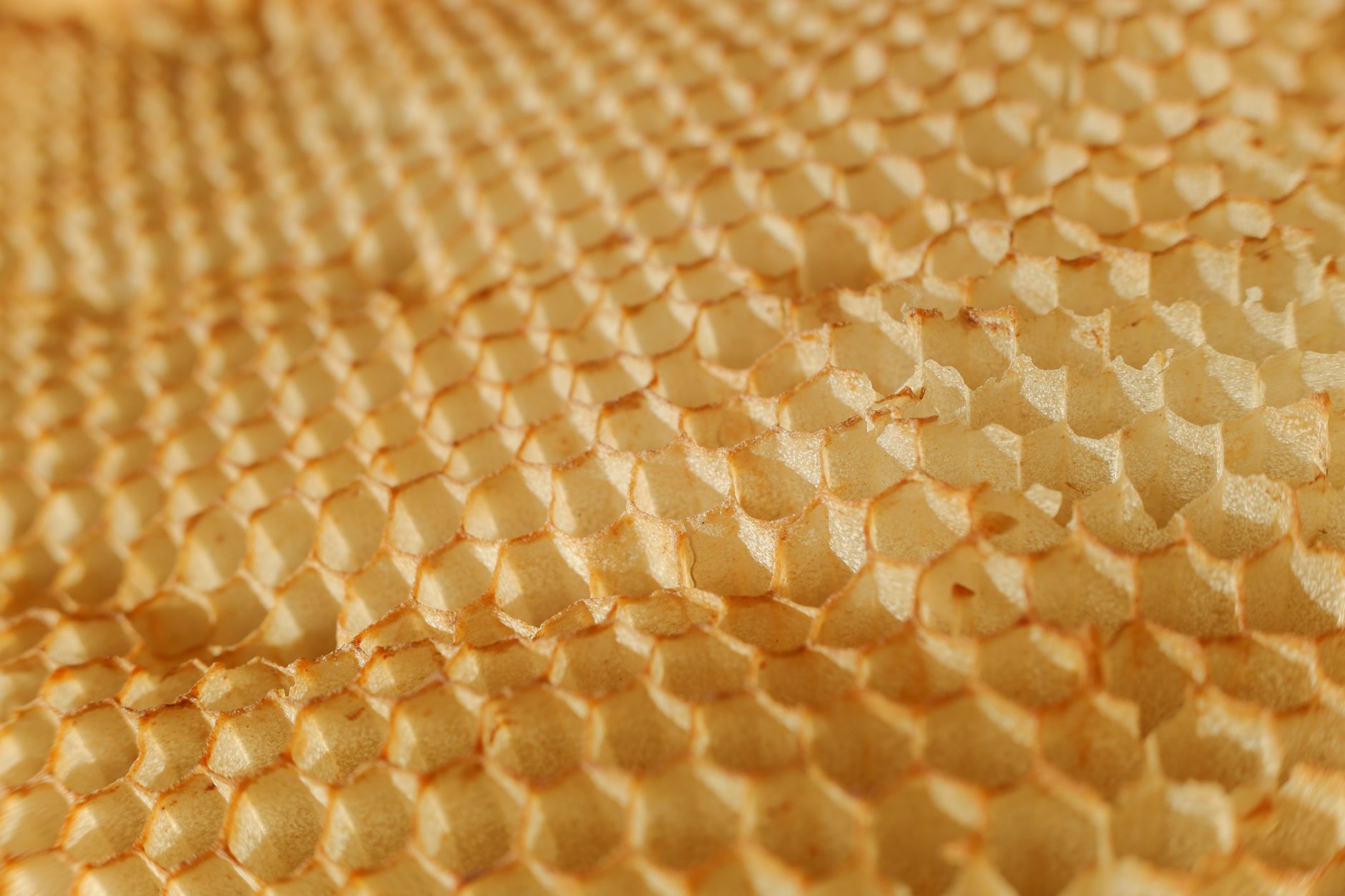
Bee-derived ingredients are a staple of Korean skincare. Korea's cosmetic ingredient register covers four of them, and three share a striking feature: the definition explains the ingredient by naming the ingredient. Only one entry does more.
The four entries
From the cosmetic raw ingredient database maintained by Korea's Ministry of Food and Drug Safety (MFDS), via the Public Data Portal at data.go.kr.
Honey Extract (꿀추출물)
이 원료는 꿀에서 추출한 것이다.
Extracted from honey.
Royal Jelly Extract (로얄젤리추출물)
이 원료는 로얄젤리에서 추출한 것이다.
Extracted from royal jelly.
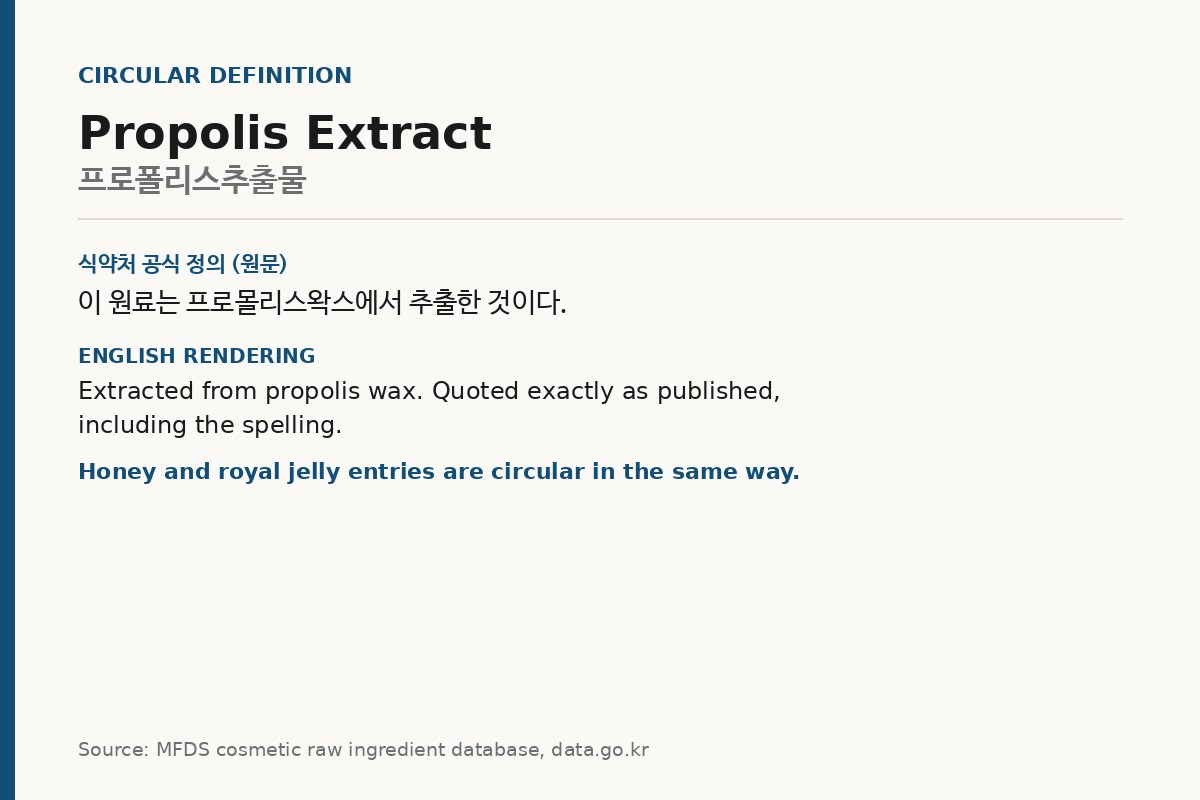
Propolis Extract (프로폴리스추출물)
이 원료는 프로몰리스왁스에서 추출한 것이다.
Extracted from propolis wax. (The Korean text reads 프로몰리스왁스 — quoted here exactly as it appears in the register, which differs by one syllable from the standard spelling 프로폴리스 used in the ingredient's own name.)
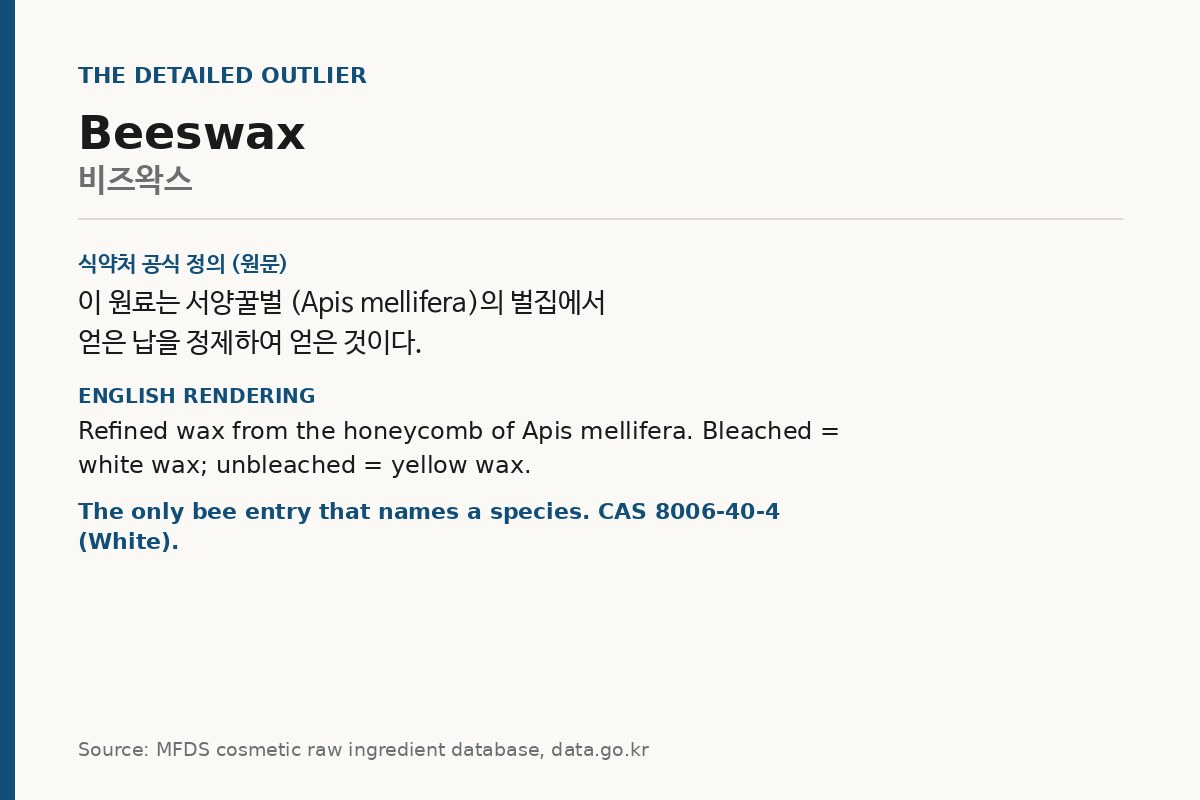
Beeswax (비즈왁스)
이 원료는 서양꿀벌 (Apis mellifera)의 벌집에서 얻은 납을 정제하여 얻은 것이다. 표백한 것은 화이트왁스(백납), 표백하지 않은 것은 옐로우왁스로 불린다.
Obtained by refining the wax taken from the honeycomb of the Western honey bee (Apis mellifera). The bleached form is called white wax; the unbleached form is called yellow wax. CAS 8006-40-4 (White), 8012-89-3.
Three circular definitions, one substantive one
Honey extract is defined as an extract of honey. Royal jelly extract is defined as an extract of royal jelly. Propolis extract is defined as an extract of propolis wax. In each case the definition assumes you already know what the source material is — the register does not characterise honey, royal jelly, or propolis anywhere in these entries.
This is not sloppiness so much as scope. The register standardises names so that the same material is called the same thing across every product sold in Korea. Characterising bee products is somebody else's job.
Beeswax is the outlier, and by a wide margin. It names the species (Apis mellifera), names the source structure (honeycomb), names a processing step (refining), and then goes further — it records that the bleached and unbleached forms have distinct common names, white wax and yellow wax. Two CAS numbers are listed, one specifically flagged as the white form.
Why beeswax gets more detail
The register does not explain why, so this article will not invent a reason. What can be observed from the text itself is that beeswax is the only one of the four where a processing choice produces two commercially distinguishable materials — and the entry records exactly that distinction, along with separate CAS references.
For the other three, the definitions stop at the source. No processing variant is named, and no species is specified. The honey, royal jelly, and propolis entries do not restrict the bee species at all, while beeswax explicitly does.
What this means at the shelf
- Seeing "Propolis Extract" tells you propolis was the starting material. It does not tell you the extraction solvent, the concentration, or the geographic origin — all of which vary considerably in the propolis trade.
- Seeing "Beeswax" tells you more than the other three: Apis mellifera, from honeycomb, refined. Whether it is the bleached or unbleached form is not distinguishable from the ingredient name alone.
- None of the four entries states a concentration minimum.
What none of these entries state
- No efficacy. No definition claims an effect on skin.
- No standardisation of active constituents. Propolis composition is known to vary by region and season; the register does not address this.
- No allergen guidance. Bee-derived materials are a recognised sensitivity concern for some people, and an ingredient definition is not where that is handled.
- No welfare or sourcing standard.
How to verify this
- The dataset is published by MFDS through Korea's Public Data Portal (data.go.kr) as cosmetic raw ingredient information.
- Search 꿀추출물, 로얄젤리추출물, 프로폴리스추출물, 비즈왁스.
- Korean text above is quoted verbatim — including the propolis entry's spelling, which is reproduced rather than corrected. English renderings are this site's translation.
Source: Cosmetic raw ingredient information published by Korea's Ministry of Food and Drug Safety (MFDS) via the Public Data Portal, data.go.kr.
Photos by hejpetrpepa Pepa, Real Seoul Daily, Real Seoul Daily via Pexels