Ceramide NP, AP, EOP, NS: Korea's Register Maps Them to the Old Numbers
Ceramide letter codes replaced numbered names, and the mapping is hard to find in English. Korea's MFDS ingredient register states it directly. Official text quoted.

Ceramides on modern labels carry letter codes — NP, AP, EOP, NS, AS. Older products and older articles used numbers — Ceramide 1, 2, 3, 6-II. Readers routinely try to line the two systems up and find that English-language sources disagree with each other.
Korea's official cosmetic ingredient register resolves part of this directly, because several entries state the former name inside the definition itself. This article quotes those entries and is explicit about which mappings the register does not supply.
What the register actually states
All text below is from the cosmetic raw ingredient database maintained by Korea's Ministry of Food and Drug Safety (MFDS), published via the Public Data Portal at data.go.kr.
Ceramide AP (세라마이드에이피)
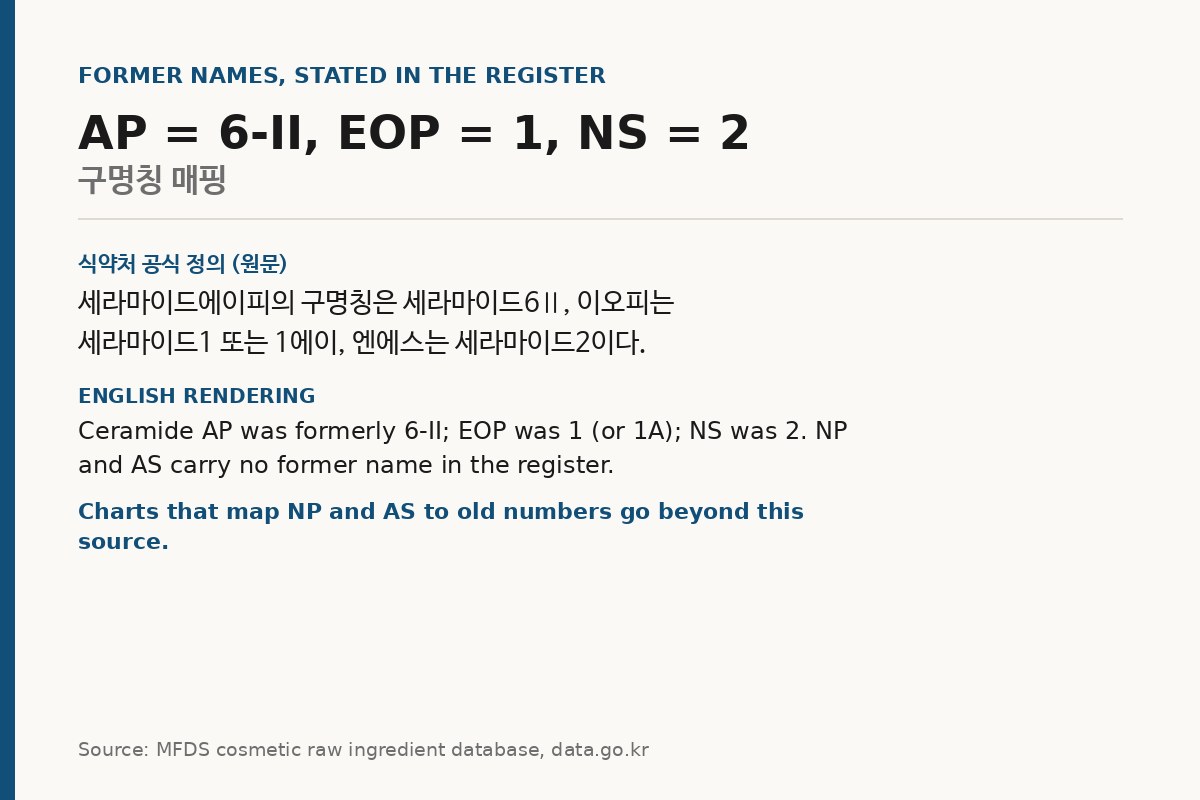
이 원료는 α-하이드록시포화 또는 불포화 지방산이 결합된 D-에리스로 구조를 갖는 피토스핑고신이 함유된 N-아실레이티드스핑고리피드로, 구명칭은 세라마이드6Ⅱ이다.
English: an N-acylated sphingolipid containing phytosphingosine with D-erythro configuration, bound to an alpha-hydroxy saturated or unsaturated fatty acid. Former name: Ceramide 6-II.
Ceramide EOP (세라마이드이오피)
이 원료는 포화 또는 불포화 지방산으로 에스터화된 ω-하이드록시에씨드와 결합된 D-에리스로 구조를 갖는 피토스핑고신이 함유된 N-아실레이티드스핑고리피드로, 구명칭은 세라마이드1 또는 세라마이드1에이이다
English: an N-acylated sphingolipid containing phytosphingosine with D-erythro configuration, bound to an omega-hydroxy acid esterified with a saturated or unsaturated fatty acid. Former name: Ceramide 1, or Ceramide 1A.
Ceramide NS (세라마이드엔에스)
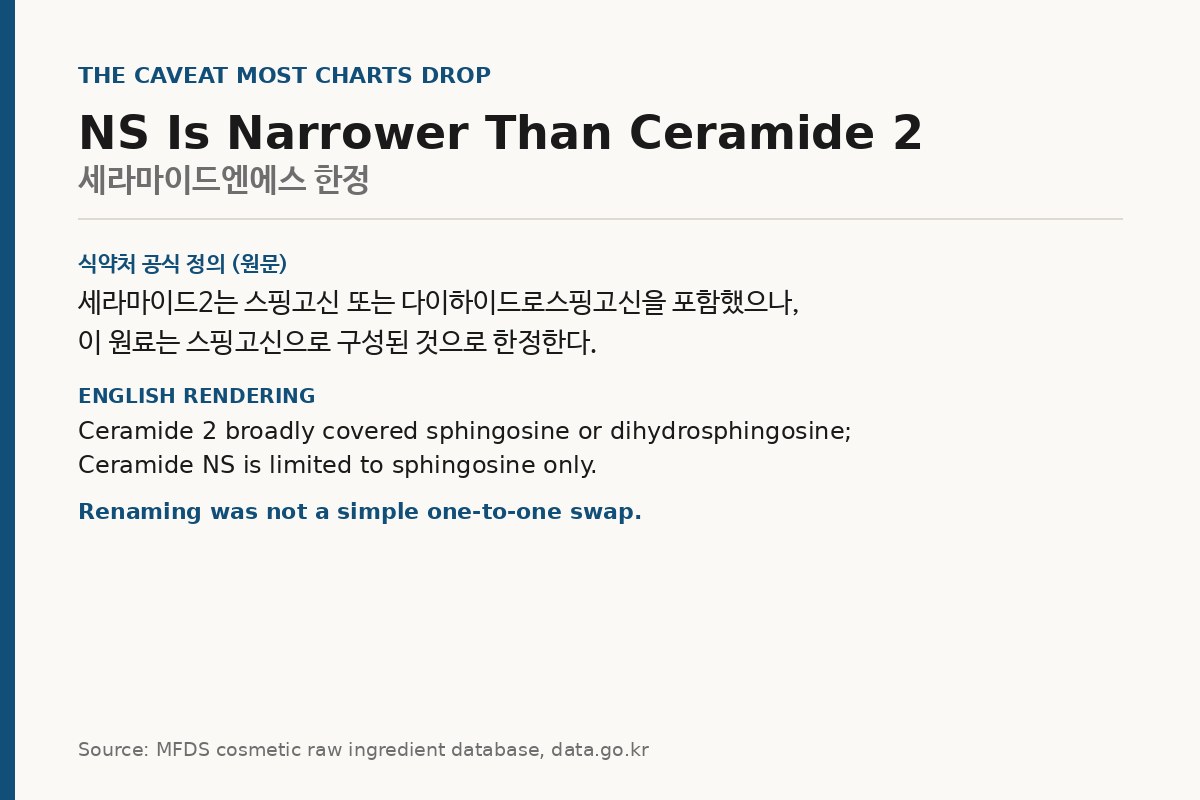
이 원료는 포화 또는 불포화 지방산이 결합된 D-에리스로 구조를 갖는 스핑고신이 함유된 N-아실레이티드스핑고리피드로, 구명칭은 세라마이드2이다. 세라마이드2의 정의가 광범위하게 스핑고신 또는 다이하이드로스핑고신(스핑가닌)으로 구성된 스핑고리피드를 포함한다는 것과 달리, 이 원료는 스핑고신으로 구성된 세라마이드로 한정한다.
English: an N-acylated sphingolipid containing sphingosine with D-erythro configuration, bound to a saturated or unsaturated fatty acid. Former name: Ceramide 2. The entry then adds a qualification: whereas the definition of Ceramide 2 broadly included sphingolipids composed of sphingosine or dihydrosphingosine (sphinganine), this raw material is limited to ceramides composed of sphingosine.
That last sentence is the most useful line in the whole set, and it is easy to miss. Ceramide NS is not simply a renamed Ceramide 2 — it is narrower than Ceramide 2 was. The old name covered a wider group. Anyone treating the two as interchangeable is treating a subset as if it were the whole set.
Where the register is silent
Two entries in this family carry no former-name statement:
Ceramide NP (세라마이드엔피)
이 원료는 D-에리스로구조를 갖는 피토스핑고신에 포화 또는 불포화지방산이 결합된 합성N-아실화스핑고리피드이다.
English: a synthetic N-acylated sphingolipid in which phytosphingosine with D-erythro configuration is bound to a saturated or unsaturated fatty acid. No former name is given.
Note also the word 합성 — synthetic. The register states outright that this material is synthesised. That is a compositional fact, not a quality judgement, and it applies regardless of how a product markets the ingredient.
Ceramide AS (세라마이드에이에스)
이 원료는 포화 또는 불포화 알파-하이드록시지방산이 결합된 D-에리스로 구조를 갖는 스핑고신으로 구성되는 N-아실화스핑고리피드이다.
English: an N-acylated sphingolipid composed of sphingosine with D-erythro configuration, bound to a saturated or unsaturated alpha-hydroxy fatty acid. No former name is given.
Widely circulated charts do assign old numbers to NP and AS. This register does not, and this article will not repeat a mapping the source does not support.
Reading the letter codes
A pattern is visible across the definitions themselves, without needing an outside source. Comparing the five entries:
- Entries beginning with N (NP, NS) describe a fatty acid with no additional hydroxyl specified.
- Entries beginning with A (AP, AS) describe an alpha-hydroxy fatty acid.
- The entry beginning with EO (EOP) describes an omega-hydroxy acid esterified with a further fatty acid.
- Entries ending in P (NP, AP, EOP) contain phytosphingosine.
- Entries ending in S (NS, AS) contain sphingosine.
So the code reads as fatty-acid type first, sphingoid base second. This is consistent across all five definitions quoted above — it is an observation drawn from the register text, not an external claim.
What these entries do not tell you
- Nothing about efficacy. The register describes composition. It does not state that any ceramide repairs a barrier, and it does not rank them.
- Nothing about concentration. No minimum is set, so the presence of a ceramide name on a label carries no quantity information.
- Nothing about which combination is preferable. Formulation strategy is outside the scope of an ingredient definition.
How to verify this
- The dataset is published by MFDS through Korea's Public Data Portal (data.go.kr) as cosmetic raw ingredient information.
- Search the Korean names 세라마이드엔피, 세라마이드에이피, 세라마이드이오피, 세라마이드엔에스, 세라마이드에이에스, or the standardised English names.
- Korean text above is quoted verbatim from the register; English renderings are this site's translation.
The practical takeaway
If you are trying to match a modern ceramide code to an older article, the register gives you three answers with certainty — AP was 6-II, EOP was 1 (or 1A), NS was 2 — and declines to answer for NP and AS.
The single most useful detail is the caveat attached to NS: the letter-coded ingredient is narrower than the numbered one it replaced. Renaming was not purely cosmetic, and a chart that shows a simple one-to-one swap is losing that information.
Source: Cosmetic raw ingredient information published by Korea's Ministry of Food and Drug Safety (MFDS) via the Public Data Portal, data.go.kr.
Photos by Tima Miroshnichenko, Real Seoul Daily, Real Seoul Daily via Pexels