Snail Mucin: What Korea's Official Ingredient Record Actually Says
Korea's cosmetic ingredient database defines snail secretion filtrate in one sentence, with no benefit claims. Here is the official text and what it does not cover.

Snail secretion filtrate is one of the most heavily marketed ingredients in Korean skincare. Product pages describe it as repairing, regenerating, and healing. Korea's own regulatory record describes it in a single sentence, and that sentence contains none of those words.
This article quotes the official entry, explains what it establishes, and is explicit about what it does not establish. Every factual claim below is traceable to a public source you can check yourself.
The official entry, quoted in full
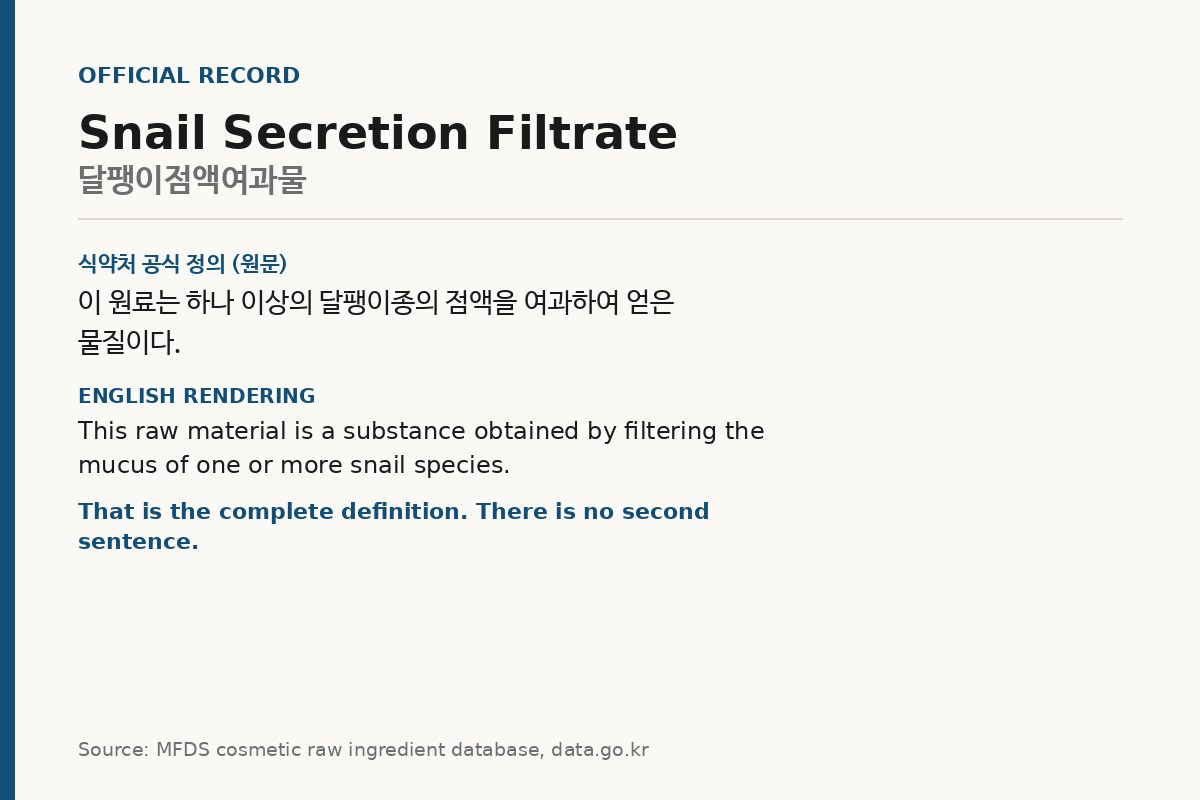
Korea's Ministry of Food and Drug Safety (MFDS) maintains a database of cosmetic raw ingredients, published through the national Public Data Portal at data.go.kr. The entry for snail mucin reads, in the original Korean:
이 원료는 하나 이상의 달팽이종의 점액을 여과하여 얻은 물질이다.
Translated as literally as the grammar allows:
This raw material is a substance obtained by filtering the mucus of one or more snail species.
- Korean name: 달팽이점액여과물
- English name on the register: Snail Secretion Filtrate
- CAS number: none assigned in the register
That is the complete definition. There is no second sentence.
What the entry establishes
Three things, and they are worth separating carefully.
It establishes origin. The material comes from snail mucus. Not a synthetic analogue, not a plant-derived substitute.
It establishes a process. Filtration. The word used is 여과 — filtering — which describes separation, not chemical transformation. The register does not specify filter size, and it does not specify what is removed.
It establishes species ambiguity as acceptable. The phrase 하나 이상의 달팽이종 means "one or more snail species." The register does not require a single named species. Two products can both carry this ingredient name and be derived from different snails.
What the entry does not establish
This is the part that matters for anyone reading marketing copy.
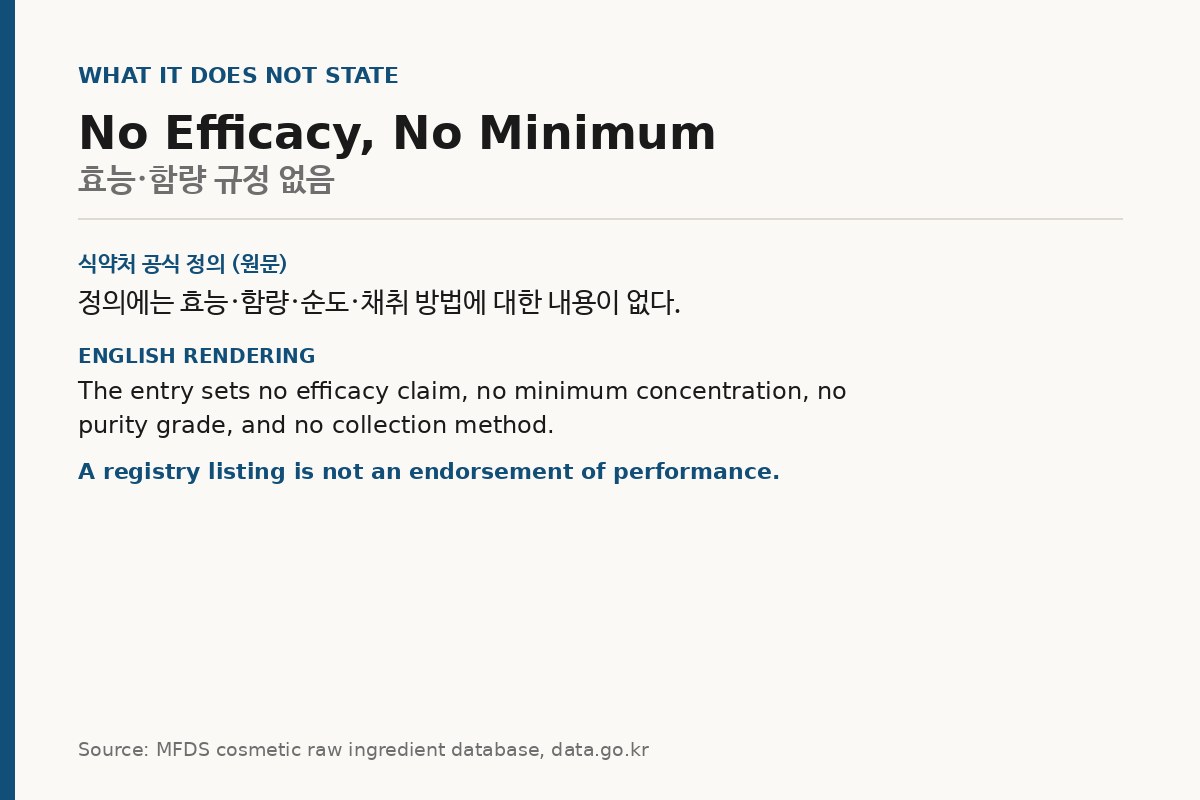
- No efficacy claim. The definition does not state what the ingredient does to skin. Not repair, not hydration, not barrier support. The register is a compositional record, not a performance record.
- No concentration requirement. Nothing in the entry sets a minimum percentage. A formula containing a trace amount and a formula built around it can both list the same ingredient name.
- No purity or grade standard. Filtration is named as the process; no specification follows.
- No collection method. How the mucus is obtained from the animal is outside the scope of this entry entirely.
None of this means the ingredient is ineffective. It means the register is silent on effectiveness, and a regulatory listing should not be read as an endorsement. Those are different statements, and marketing copy frequently blurs them.
Why the ingredient name on a Korean label is a weak signal
Korean cosmetic labels list ingredients using standardised names drawn from this register. That standardisation is genuinely useful: it means the same substance carries the same name across brands, so you can compare formulas.
What it cannot tell you is how much is present. The register sets no minimum concentration for this ingredient, so a formula built around snail filtrate and a formula containing a trace of it can carry the same ingredient name, spelled identically, on the label.
The name also cannot tell you which snail species was used, because the definition explicitly permits "one or more." Two products with identical ingredient names may not contain identical material.
How to check this yourself
The database is public. You do not have to take this article's word for the quoted text.
- The dataset is published by MFDS through Korea's Public Data Portal (data.go.kr), under cosmetic raw ingredient information.
- Entries are searchable by the Korean ingredient name (달팽이점액여과물) or the standardised English name (Snail Secretion Filtrate).
- Where a CAS number exists, it is listed and can be cross-checked against chemical registries. For this ingredient, none is assigned.
What this article does not cover
Deliberately, several things:
- Clinical evidence. Whether snail filtrate performs as claimed is a question for published studies, not for an ingredient register. This article makes no claim in either direction.
- Specific products. No formulation is assessed here, because the register says nothing about individual formulations.
- Animal welfare. Collection practices are genuinely contested and genuinely important, and they fall entirely outside the scope of this record.
The practical takeaway
When a product page says an ingredient is "approved" or "registered" in Korea, that phrasing describes something narrower than most readers assume. It means the substance appears in a compositional register under a standardised name. It does not mean a regulator evaluated whether it works.
For snail mucin specifically, the register commits to one sentence: filtered mucus from one or more snail species. Anything beyond that — how much, from which species, processed how, to what effect — is a question the official record leaves open, and one that a label cannot answer for you.
Source: Cosmetic raw ingredient information published by Korea's Ministry of Food and Drug Safety (MFDS) via the Public Data Portal, data.go.kr. Korean text quoted verbatim from the register entry; English rendering is this site's translation.
Images by Zachi Evenor (CC BY 2.0), Real Seoul Daily, Real Seoul Daily via Wikimedia Commons