Squalane: Korea's Official Definition Still Names Shark Liver Oil
The MFDS ingredient register defines squalane as hydrogenated shark liver oil or other natural oils. The label word is identical either way. Here is the official text.
Squalane appears on thousands of product labels as a single word. Korea's official cosmetic ingredient register defines that single word in a way that covers two very different origins — and one of them is shark.
For anyone avoiding animal-derived ingredients, this matters, because the label gives no way to tell which one you are holding.
The official entry
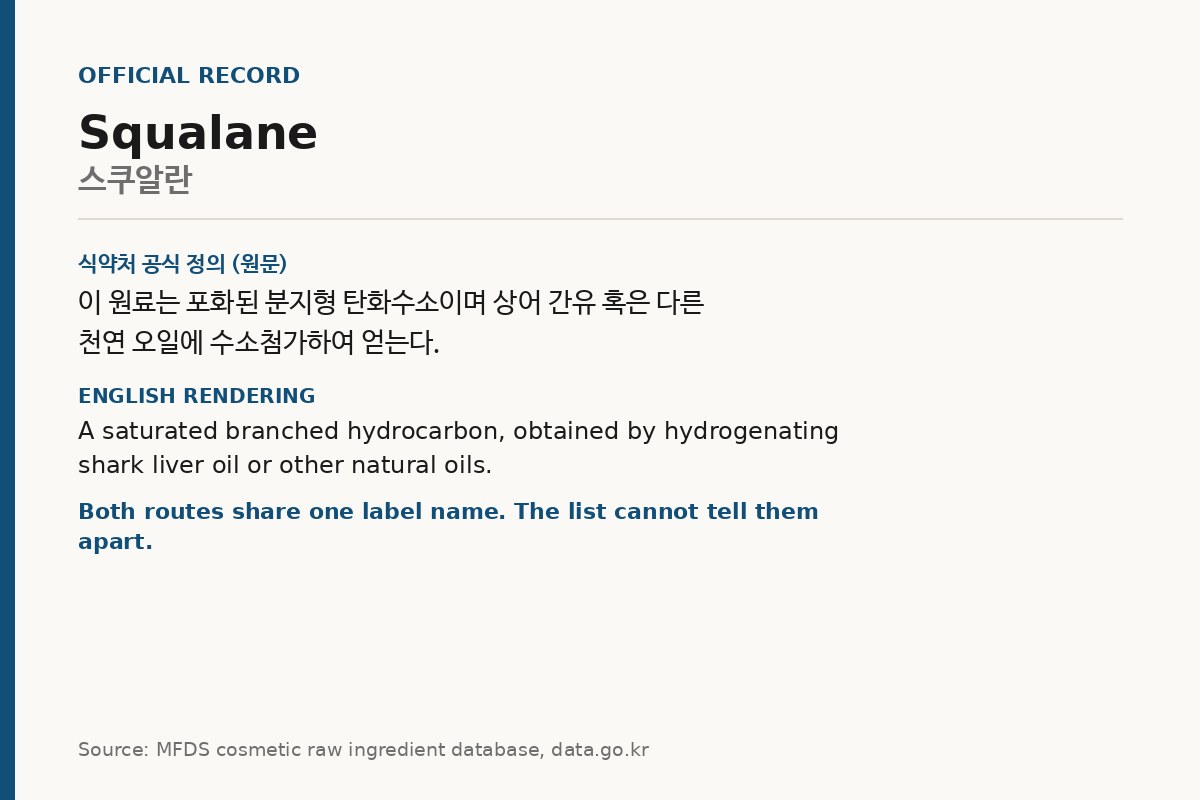
From the cosmetic raw ingredient database maintained by Korea's Ministry of Food and Drug Safety (MFDS), published via the national Public Data Portal at data.go.kr:
이 원료는 포화된 분지형 탄화수소이며 상어 간유 혹은 다른 천연 오일에 수소첨가하여 얻는다.
Rendered into English:
This raw material is a saturated branched hydrocarbon, obtained by hydrogenating shark liver oil or other natural oils.
- Korean name: 스쿠알란
- English name on the register: Squalane
Reading the definition precisely
Two clauses do the work here.
"Saturated branched hydrocarbon" describes the finished molecule. This is the chemistry, and it is the same regardless of where the starting material came from. Squalane derived from olives and squalane derived from shark are, at the molecular level, the same compound.
"Shark liver oil or other natural oils" (상어 간유 혹은 다른 천연 오일) describes the feedstock, and it is deliberately plural. The register names shark liver oil explicitly and then allows unspecified alternatives. It does not rank them, restrict them, or require disclosure of which was used.
The word 혹은 is an ordinary "or." Both routes sit inside the same registered ingredient name.
What this means at the shelf
The consequence is straightforward and slightly uncomfortable: the ingredient list cannot answer the question.
- A plant-derived squalane and a shark-derived squalane both appear on a label as "Squalane."
- The register does not require the source to be stated.
- Because the molecules are identical, no ingredient-list inspection can distinguish them.
This is why brands that use plant sources tend to say so in marketing copy rather than in the ingredient list — the ingredient list has no field for it. Phrases like "olive-derived squalane" or "sugarcane-derived squalane" are voluntary brand claims sitting outside the regulated ingredient name.
It also means the absence of such a claim is genuinely ambiguous. A brand that does not mention the source may be using a plant route and simply not advertising it, or may not be.
What the register does not tell you
- Which source any given product used. That information is not in this record and is not required on the label.
- Market share between the routes. The register is a definition, not a survey. This article makes no claim about how common each source currently is.
- Anything about performance. The entry is compositional. It says nothing about how squalane behaves on skin.
- Sustainability or welfare. Entirely outside the scope of an ingredient definition.
A related entry worth knowing
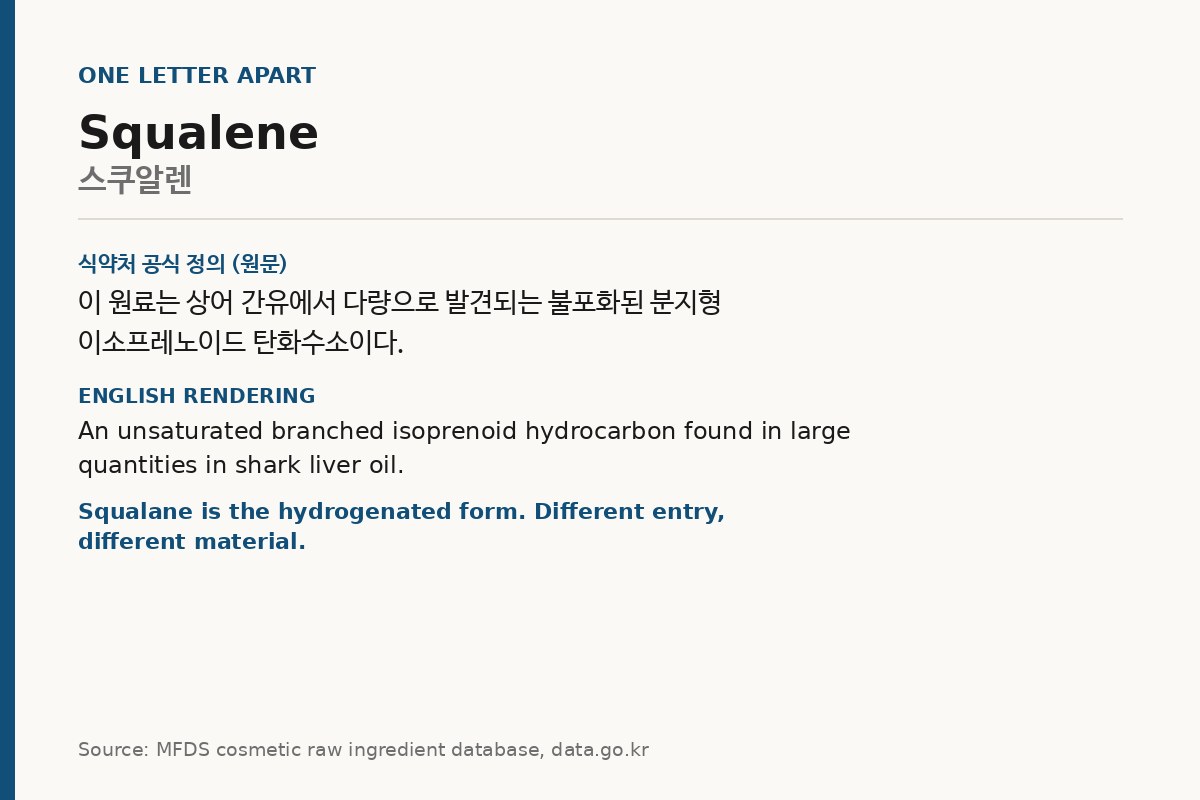
The same register lists Squalene — with an "e" — as a separate ingredient, and its definition is even more direct about origin:
이 원료는 상어 간유에서 다량으로 발견되는 불포화된 분지형 이소프레노이드 탄화수소이다.
This raw material is an unsaturated branched isoprenoid hydrocarbon found in large quantities in shark liver oil.
Note the difference in how the two entries are written. The squalene definition describes where the compound is found in nature and names only shark liver oil. The squalane definition describes how the material is obtained and allows other natural oils alongside it.
Chemically, squalane is the hydrogenated, saturated form; squalene is the unsaturated precursor. They are one letter apart on a label and are not the same material — a distinction easy to miss when scanning an ingredient list quickly.
How to verify this
- The dataset is published by MFDS through Korea's Public Data Portal (data.go.kr) as cosmetic raw ingredient information.
- Search the Korean name 스쿠알란 or the standardised English name Squalane.
- The Korean sentence quoted above is the register text as published; the English above is this site's translation.
The practical takeaway
If avoiding animal-derived ingredients matters to you, squalane is a case where reading the ingredient list is not enough — not because the list is hiding something, but because the registered ingredient name was defined broadly enough to cover both routes from the start.
The only reliable path is an explicit source claim from the brand. Where that claim is absent, the official record does not fill the gap, and no amount of label-reading will.
Source: Cosmetic raw ingredient information published by Korea's Ministry of Food and Drug Safety (MFDS) via the Public Data Portal, data.go.kr. Korean text quoted verbatim from the register entry; English rendering is this site's translation.
Images by JillWellington, Real Seoul Daily, Real Seoul Daily via Pixabay